Error Reading or Writing History File Powershell
 | |
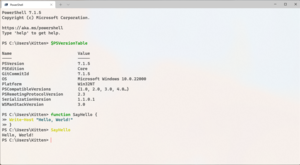 Screenshot of a PowerShell Cadre session in Windows Terminal | |
| Paradigm | Imperative, pipeline, object-oriented, functional and reflective |
|---|---|
| Designed by | Jeffrey Snover, Bruce Payette, James Truher (et al.) |
| Developer | Microsoft |
| First appeared | November fourteen, 2006 (2006-eleven-14) |
| Stable release | 7.2.1 / Dec 15, 2021 (2021-12-15) [2] |
| Preview release | v7.2.0-rc.i[1] / Oct 23, 2021 (2021-10-23) |
| Typing field of study | Strong, condom, implicit and dynamic |
| Implementation linguistic communication | C# |
| Platform | .NET Framework, .NET |
| OS |
|
| License | MIT License[three] (but the Windows component remains proprietary) |
| Filename extensions |
|
| Website | microsoft |
| Influenced by | |
| Python, Ksh, Perl, C#, CL, DCL, SQL, Tcl, Tk,[4] Chef, Puppet | |
PowerShell or Microsoft PowerShell (formerly Windows PowerShell) is a task automation and configuration management program from Microsoft, consisting of a command-line beat out and the associated scripting linguistic communication. Initially a Windows component only, known as Windows PowerShell, it was made open-source and cross-platform on 18 August 2016 with the introduction of PowerShell Core.[5] The former is built on the .NET Framework, the latter on .NET Core. The proper noun Windows PowerShell is still present on the latest versions of Windows 11 and 10, simply the latest versions of PowerShell are chosen PowerShell or Microsoft PowerShell.
In PowerShell, administrative tasks are generally performed by cmdlets (pronounced command-lets), which are specialized .NET classes implementing a particular functioning. These work by accessing information in unlike data stores, like the file system or registry, which are fabricated available to PowerShell via providers. 3rd-party developers can add cmdlets and providers to PowerShell.[6] [7] Cmdlets may exist used by scripts, which may in turn be packaged into modules.
PowerShell provides access to COM and WMI, enabling administrators to perform administrative tasks on both local and remote Windows systems as well as WS-Management and CIM enabling management of remote Linux systems and network devices. PowerShell also provides a hosting API with which the PowerShell runtime tin can exist embedded within other applications. These applications can then use PowerShell functionality to implement certain operations, including those exposed via the graphical interface. This capability has been used by Microsoft Commutation Server 2007 to expose its management functionality every bit PowerShell cmdlets and providers and implement the graphical management tools as PowerShell hosts which invoke the necessary cmdlets.[6] [8] Other Microsoft applications including Microsoft SQL Server 2008 besides betrayal their management interface via PowerShell cmdlets.[nine]
PowerShell includes its own extensive, console-based assist (similar to man pages in Unix shells) attainable via the Get-Help cmdlet. Updated local assistance contents can be retrieved from the Internet via the Update-Help cmdlet. Alternatively, help from the web can be acquired on a example-by-instance basis via the -online switch to Get-Help.
Background [edit]
Groundwork [edit]
Every version of Microsoft Windows for personal computers has included a command line interpreter (CLI) for managing the operating system. Its predecessor, MS-DOS, relied exclusively on a CLI. These are Command.COM in MS-DOS and Windows 9x, and cmd.exe in the Windows NT family unit of operating systems. Both support a few bones internal commands. For other purposes, a split panel awarding must exist written. They also include a basic scripting language (batch files), which can be used to automate various tasks. Notwithstanding, they cannot exist used to automate all facets of graphical user interface (GUI) functionality, in part considering command-line equivalents of operations are limited, and the scripting language is simple. In Windows Server 2003, the state of affairs was improved, merely scripting support was still unsatisfactory.[x]
Microsoft attempted to address some of these shortcomings by introducing the Windows Script Host in 1998 with Windows 98, and its command-line based host, cscript.exe. It integrates with the Agile Script engine and allows scripts to be written in compatible languages, such as JScript and VBScript, leveraging the APIs exposed by applications via the component object model (COM). However, it has its own deficiencies: its documentation is non very accessible, and it chop-chop gained a reputation as a organization vulnerability vector after several high-profile computer viruses exploited weaknesses in its security provisions. Unlike versions of Windows provided various special-purpose control-line interpreters (such every bit netsh and WMIC) with their own command sets but they were not interoperable.
Kermit [edit]
By the late 1990s, Intel had come to Microsoft request for help in making Windows, which ran on Intel CPUs, a more appropriate platform to support the development of future Intel CPUs. At the time, Intel CPU development was accomplished on Dominicus Microsystems computers which ran Solaris (a Unix variant) on RISC-architecture CPUs. The ability to run Intel's many KornShell automation scripts on Windows was identified as a key capability. Internally, Microsoft began an attempt to create a Windows port of Korn Shell, which was code-named Kermit.[11] Intel ultimately pivoted to a Linux-based development platform that could run on Intel CPUs, rendering the Kermit project redundant. However, with a fully funded team, Microsoft program director Jeffrey Snover realized there was an opportunity to create a more general-purpose solution to Microsoft's problem of administrative automation.
Monad [edit]
Past 2002, Microsoft had started to develop a new approach to command-line management, including a CLI called Monad (as well known as Microsoft Beat or MSH). The ideas backside it were published in August 2002 in a white paper called the "Monad Manifesto" past its principal architect, Jeffrey Snover.[12] In a 2017 interview, Snover explains the genesis of PowerShell, saying that he had been trying to make Unix tools available on Windows, which didn't piece of work due to "core architectural departure[s] between Windows and Linux". Specifically, he noted that Linux considers everything an ASCII text file, whereas Windows considers everything an "API that returns structured data". They were fundamentally incompatible, which led him to take a different approach.[13]
Monad was to be a new extensible CLI with a fresh blueprint capable of automating a range of core administrative tasks. Microsoft showtime demonstrated Monad publicly at the Professional Evolution Conference in Los Angeles in Oct 2003. A few months later, they opened upwardly private beta, which eventually led to a public beta. Microsoft published the start Monad public beta release on 17 June 2005 and the Beta two on 11 September 2005, and Beta 3 on ten January 2006.
PowerShell [edit]
On 25 Apr 2006, not long afterwards the initial Monad announcement, Microsoft announced that Monad had been renamed Windows PowerShell, positioning it as a significant office of its direction applied science offerings.[14] Release Candidate (RC) 1 of PowerShell was released at the aforementioned time. A significant attribute of both the name change and the RC was that this was now a component of Windows, rather than a mere add-on.
Release Candidate two of PowerShell version ane was released on 26 September 2006, with final release to the spider web on 14 November 2006. PowerShell for earlier versions of Windows was released on thirty January 2007.[xv] PowerShell v2.0 development began before PowerShell v1.0 shipped. During the development, Microsoft shipped three community technology previews (CTP). Microsoft made these releases bachelor to the public. The last CTP release of Windows PowerShell v2.0 was fabricated available in December 2008.
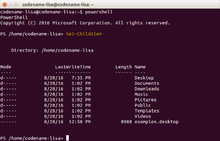
PowerShell for Linux 6.0 Alpha 9 on Ubuntu xiv.04 x64
PowerShell v2.0 was completed and released to manufacturing in August 2009, as an integral role of Windows 7 and Windows Server 2008 R2. Versions of PowerShell for Windows XP, Windows Server 2003, Windows Vista and Windows Server 2008 were released in October 2009 and are bachelor for download for both 32-bit and 64-bit platforms.[xvi] In an October 2009 event of TechNet Mag, Microsoft chosen proficiency with PowerShell "the single most important skill a Windows administrator will demand in the coming years".[17]
Windows 10 shipped a testing framework for PowerShell.[18]
On 18 Baronial 2016, Microsoft announced[19] that they had fabricated PowerShell open up-source and cantankerous-platform with support for Windows, macOS, CentOS and Ubuntu.[5] The source code was published on GitHub.[xx] The move to open source created a 2nd incarnation of PowerShell called "PowerShell Core", which runs on .Net Core. It is distinct from "Windows PowerShell", which runs on the full .Cyberspace Framework.[21] Starting with version 5.1, PowerShell Core is arranged with Windows Server 2016 Nano Server.[22] [23]
Design [edit]
A key blueprint tactic for PowerShell was to leverage the large number of APIs that already existed in Windows, Windows Management Instrumentation, .NET Framework, and other software. PowerShell cmdlets "wrap around" existing functionality. The intent with this tactic is to provide an administrator-friendly, more-consistent interface betwixt administrators and a wide range of underlying functionality. With PowerShell, an administrator doesn't need to know .Internet, WMI, or low-level API coding, and tin can instead focus on using the cmdlets exposed by PowerShell. In this regard, PowerShell creates little new functionality, instead focusing on making existing functionality more than accessible to a detail audition.[24]
Grammar [edit]
PowerShell'south developers based the core grammar of the tool on that of the POSIX 1003.2 KornShell.[25]
However, PowerShell'due south language was also influenced by PHP, Perl, and many other existing languages.[26]
Named Commands [edit]
Windows PowerShell tin execute four kinds of named commands:[27]
- cmdlets (.NET Framework programs designed to interact with PowerShell)
- PowerShell scripts (files suffixed by
.ps1) - PowerShell functions
- Standalone executable programs
If a control is a standalone executable program, PowerShell launches it in a separate procedure; if it is a cmdlet, it executes in the PowerShell process. PowerShell provides an interactive command-line interface, where the commands can be entered and their output displayed. The user interface offers customizable tab completion. PowerShell enables the creation of aliases for cmdlets, which PowerShell textually translates into invocations of the original commands. PowerShell supports both named and positional parameters for commands. In executing a cmdlet, the job of binding the argument value to the parameter is done past PowerShell itself, but for external executables, arguments are parsed by the external executable independently of PowerShell interpretation.[28]
Extended Type System [edit]
The PowerShell Extended Type System (ETS) is based on the .Net type organization, but with extended semantics (for example, propertySets and third-party extensibility). For instance, it enables the creation of different views of objects by exposing only a subset of the information fields, properties, and methods, equally well as specifying custom formatting and sorting behavior. These views are mapped to the original object using XML-based configuration files.[29]
Cmdlets [edit]
Cmdlets are specialized commands in the PowerShell environment that implement specific functions. These are the native commands in the PowerShell stack. Cmdlets follow a Verb-Noun naming pattern, such as Become-ChildItem, which makes it self-documenting lawmaking.[thirty] Cmdlets output their results every bit objects and can also receive objects as input, making them suitable for utilise as recipients in a pipeline. If a cmdlet outputs multiple objects, each object in the drove is passed down through the unabridged pipeline before the adjacent object is processed.[30]
Cmdlets are specialized .Internet classes, which the PowerShell runtime instantiates and invokes at execution time. Cmdlets derive either from Cmdlet or from PSCmdlet, the latter existence used when the cmdlet needs to interact with the PowerShell runtime.[30] These base of operations classes specify sure methods – BeginProcessing(), ProcessRecord() and EndProcessing() – which the cmdlet's implementation overrides to provide the functionality. Whenever a cmdlet runs, PowerShell invokes these methods in sequence, with ProcessRecord() being called if information technology receives pipeline input.[31] If a collection of objects is piped, the method is invoked for each object in the drove. The class implementing the cmdlet must take one .NET attribute – CmdletAttribute – which specifies the verb and the noun that make upwards the name of the cmdlet. Mutual verbs are provided as an enum.[32] [33]
If a cmdlet receives either pipeline input or command-line parameter input, there must exist a corresponding holding in the class, with a mutator implementation. PowerShell invokes the mutator with the parameter value or pipeline input, which is saved by the mutator implementation in class variables. These values are then referred to by the methods which implement the functionality. Properties that map to command-line parameters are marked by ParameterAttribute [34] and are set up before the telephone call to BeginProcessing(). Those which map to pipeline input are also flanked by ParameterAttribute, just with the ValueFromPipeline attribute parameter ready.[35]
The implementation of these cmdlet classes tin can refer to whatsoever .Cyberspace API and may be in any .NET language. In addition, PowerShell makes certain APIs available, such every bit WriteObject(), which is used to access PowerShell-specific functionality, such as writing resultant objects to the pipeline. Cmdlets can use .NET data access APIs directly or use the PowerShell infrastructure of PowerShell Providers, which make data stores addressable using unique paths. Data stores are exposed using drive letters, and hierarchies within them, addressed as directories. Windows PowerShell ships with providers for the file arrangement, registry, the certificate store, as well as the namespaces for command aliases, variables, and functions.[36] Windows PowerShell also includes diverse cmdlets for managing various Windows systems, including the file organisation, or using Windows Direction Instrumentation to control Windows components. Other applications can register cmdlets with PowerShell, thus allowing information technology to manage them, and, if they enclose any datastore (such as a database), they can add together specific providers as well.[ citation needed ]
The number of cmdlets included in the base PowerShell install has generally increased with each version:
| Version | Cmdlets |
|---|---|
| Windows PowerShell ane.0 | 129[37] |
| Windows PowerShell 2.0 | 632[38] |
| Windows PowerShell 3.0 | almost 1,000[39] |
| Windows PowerShell 4.0 | ? |
| Windows PowerShell five.0 | most 1,300[forty] |
| Windows PowerShell five.1 | 1586[ citation needed ] |
| PowerShell Cadre 6.0 | ? |
| PowerShell Core 6.1 | ? |
| PowerShell Cadre six.2 | ? |
| PowerShell 7.0 | 1507[ citation needed ] |
| PowerShell 7.one | ? |
| PowerShell 7.2 | ? |
Cmdlets tin can be added into the vanquish through snap-ins (deprecated in v2) and modules; users are not limited to the cmdlets included in the base of operations PowerShell installation.
Pipeline [edit]
PowerShell implements the concept of a pipeline, which enables piping the output of 1 cmdlet to another cmdlet as input. For case, the output of the Get-Process cmdlet could be piped to the Where-Object to filter any process that has less than 1 MB of paged retention, and then to the Sort-Object cmdlet (e.g., to sort the objects past handle count), and and then finally to the Select-Object cmdlet to select just the first 10 processes based on handle count.[ citation needed ]
As with Unix pipelines, PowerShell pipelines can construct complex commands, using the | operator to connect stages. Notwithstanding, the PowerShell pipeline differs from Unix pipelines in that stages execute inside the PowerShell runtime rather than as a ready of processes coordinated by the operating organization. Additionally, structured .NET objects, rather than byte streams, are passed from one phase to the next. Using objects and executing stages inside the PowerShell runtime eliminates the need to serialize data structures, or to extract them past explicitly parsing text output.[41] An object tin too encapsulate certain functions that work on the contained information, which go available to the recipient command for utilise.[42] [43] For the last cmdlet in a pipeline, PowerShell automatically pipes its output object to the Out-Default cmdlet, which transforms the objects into a stream of format objects and and then renders those to the screen.[44] [45]
Because all PowerShell objects are .NET objects, they share a .ToString() method, which retrieves the text representation of the information in an object. In addition, PowerShell allows formatting definitions to be specified, and so the text representation of objects tin exist customized by choosing which information elements to brandish, and in what manner. All the same, in order to maintain backward compatibility, if an external executable is used in a pipeline, it receives a text stream representing the object, instead of directly integrating with the PowerShell blazon arrangement.[46] [47] [48]
Scripting [edit]
Windows PowerShell includes a dynamically typed scripting language which can implement circuitous operations using cmdlets imperatively. The scripting language supports variables, functions, branching (if-then-else), loops (while, do, for, and foreach), structured error/exception treatment and closures/lambda expressions,[49] likewise as integration with .NET. Variables in PowerShell scripts are prefixed with $. Variables can be assigned whatever value, including the output of cmdlets. Strings tin be enclosed either in single quotes or in double quotes: when using double quotes, variables will be expanded fifty-fifty if they are inside the quotation marks. Enclosing the path to a file in braces preceded by a dollar sign (equally in ${C:\foo.txt}) creates a reference to the contents of the file. If it is used as an Fifty-value, anything assigned to information technology will be written to the file. When used every bit an R-value, the contents of the file volition exist read. If an object is assigned, it is serialized before being stored.[ citation needed ]
Object members can be accessed using . note, every bit in C# syntax. PowerShell provides special variables, such every bit $args, which is an array of all the control line arguments passed to a function from the command line, and $_, which refers to the current object in the pipeline.[50] PowerShell too provides arrays and associative arrays. The PowerShell scripting linguistic communication besides evaluates arithmetics expressions entered on the command line immediately, and information technology parses common abbreviations, such every bit GB, MB, and KB.[51] [52]
Using the function keyword, PowerShell provides for the creation of functions. A simple part has the following general look:[53]
function proper noun ( [Blazon] $Param1 , [Type] $Param2 ) { # Instructions } Withal, PowerShell allows for avant-garde functions that back up named parameters, positional parameters, switch parameters and dynamic parameters.[53]
function Verb-Substantive { param ( # Definition of static parameters ) dynamicparam { # Definition of dynamic parameters } begin { # Fix of didactics to run at the start of the pipeline } process { # Master instruction sets, ran for each item in the pipeline } finish { # Prepare of pedagogy to run at the end of the pipeline } } The defined function is invoked in either of the following forms:[53]
name value1 value2 Verb-Substantive -Param1 value1 -Param2 value2 PowerShell allows whatever static .Internet methods to be chosen by providing their namespaces enclosed in brackets ([]), and then using a pair of colons (::) to point the static method.[54] For case:
[Panel] :: WriteLine ( "PowerShell" ) There are dozens of means to create objects in PowerShell. Once created, one tin admission the properties and instance methods of an object using the . notation.[54]
PowerShell accepts strings, both raw and escaped. A string enclosed between single quotation marks is a raw string while a string enclosed betwixt double quotation marks is an escaped cord. PowerShell treats directly and curly quotes as equivalent.[55]
The following listing of special characters is supported past PowerShell:[56]
For error handling, PowerShell provides a .Net-based exception-handling machinery. In case of errors, objects containing information about the error (Exception object) are thrown, which are caught using the try ... catch construct (although a trap construct is supported as well). PowerShell can be configured to silently resume execution, without actually throwing the exception; this can exist done either on a single command, a single session or perpetually.[57]
Scripts written using PowerShell tin be made to persist beyond sessions in either a .ps1 file or a .psm1 file (the latter is used to implement a module). Later on, either the entire script or individual functions in the script tin can be used. Scripts and functions operate analogously with cmdlets, in that they tin be used as commands in pipelines, and parameters tin be leap to them. Pipeline objects tin can be passed between functions, scripts, and cmdlets seamlessly. To prevent unintentional running of scripts, script execution is disabled by default and must exist enabled explicitly.[58] Enabling of scripts can be performed either at arrangement, user or session level. PowerShell scripts can be signed to verify their integrity, and are subject to Lawmaking Access Security.[59]
The PowerShell scripting language supports binary prefix annotation like to the scientific note supported by many programming languages in the C-family.[threescore]
Hosting [edit]
One tin can also utilise PowerShell embedded in a management application, which uses the PowerShell runtime to implement the direction functionality. For this, PowerShell provides a managed hosting API. Via the APIs, the application tin can instantiate a runspace (ane instantiation of the PowerShell runtime), which runs in the application's process and is exposed as a Runspace object.[vi] The state of the runspace is encased in a SessionState object. When the runspace is created, the Windows PowerShell runtime initializes the instantiation, including initializing the providers and enumerating the cmdlets, and updates the SessionState object appropriately. The Runspace then must be opened for either synchronous processing or asynchronous processing. Afterward that it tin can be used to execute commands.[ citation needed ]
To execute a command, a pipeline (represented by a Pipeline object) must be created and associated with the runspace. The pipeline object is then populated with the cmdlets that make up the pipeline. For sequential operations (as in a PowerShell script), a Pipeline object is created for each statement and nested inside another Pipeline object.[6] When a pipeline is created, Windows PowerShell invokes the pipeline processor, which resolves the cmdlets into their corresponding assemblies (the control processor) and adds a reference to them to the pipeline, and associates them with InputPipe, OutputPipe and ErrorOutputPipe objects, to represent the connexion with the pipeline. The types are verified and parameters bound using reflection.[6] In one case the pipeline is set, the host calls the Invoke() method to run the commands, or its asynchronous equivalent, InvokeAsync(). If the pipeline has the Write-Host cmdlet at the finish of the pipeline, information technology writes the result onto the console screen. If not, the results are handed over to the host, which might either utilize further processing or display the output itself.[ commendation needed ]
Microsoft Exchange Server 2007 uses the hosting APIs to provide its management GUI. Each functioning exposed in the GUI is mapped to a sequence of PowerShell commands (or pipelines). The host creates the pipeline and executes them. In fact, the interactive PowerShell panel itself is a PowerShell host, which interprets the scripts entered at command line and creates the necessary Pipeline objects and invokes them.[ citation needed ]
Desired Country Configuration [edit]
DSC allows for declaratively specifying how a software environment should be configured.[61]
Upon running a configuration, DSC will ensure that the organisation gets the state described in the configuration. DSC configurations are idempotent. The Local Configuration Manager (LCM) periodically polls the organisation using the control flow described past resources (imperative pieces of DSC) to make sure that the country of a configuration is maintained.
Versions [edit]
Initially using the lawmaking name "Monad", PowerShell was first shown publicly at the Professional Developers Conference in October 2003 in Los Angeles. All major releases are withal supported, and each major release has featured backwards compatibility with preceding versions.
Windows PowerShell 1.0 [edit]
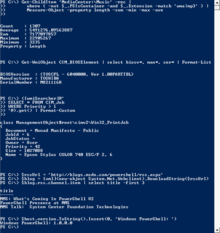
PowerShell 1.0 was released in November 2006 for Windows XP SP2, Windows Server 2003 SP1 and Windows Vista.[62] It is an optional component of Windows Server 2008.
Windows PowerShell two.0 [edit]

PowerShell 2.0 is integrated with Windows 7 and Windows Server 2008 R2[63] and is released for Windows XP with Service Pack 3, Windows Server 2003 with Service Pack 2, and Windows Vista with Service Pack 1.[64] [65]
PowerShell v2 includes changes to the scripting linguistic communication and hosting API, in addition to including more than 240 new cmdlets.[66] [67]
New features of PowerShell 2.0 include:[68] [69] [lxx]
- PowerShell remoting: Using WS-Management, PowerShell 2.0 allows scripts and cmdlets to be invoked on a remote automobile or a large set of remote machines.
- Background jobs: Too called a PSJob, information technology allows a command sequence (script) or pipeline to be invoked asynchronously. Jobs can exist run on the local machine or on multiple remote machines. An interactive cmdlet in a PSJob blocks the execution of the job until user input is provided.
- Transactions: Enable cmdlet and developers can perform transactional operations. PowerShell 2.0 includes transaction cmdlets for starting, committing, and rolling back a PSTransaction as well as features to manage and direct the transaction to the participating cmdlet and provider operations. The PowerShell Registry provider supports transactions.
- Advanced functions: These are cmdlets written using the PowerShell scripting language. Initially called "script cmdlets", this feature was later renamed "advanced functions".[71]
- SteppablePipelines: This allows the user to command when the
BeginProcessing(),ProcessRecord()andEndProcessing()functions of a cmdlet are chosen. - Modules: This allows script developers and administrators to organize and division PowerShell scripts in self-contained, reusable units. Code from a module executes in its own self-contained context and does non touch the country outside the module. Modules tin define a restricted runspace environment by using a script. They have a persistent state equally well as public and private members.
- Data language: A domain-specific subset of the PowerShell scripting language that allows data definitions to exist decoupled from the scripts and allows localized string resources to be imported into the script at runtime (Script Internationalization).
- Script debugging: It allows breakpoints to be set in a PowerShell script or function. Breakpoints can be set on lines, line & columns, commands and read or write admission of variables. It includes a set of cmdlets to command the breakpoints via script.
- Eventing: This feature allows listening, forwarding, and acting on management and system events. Eventing allows PowerShell hosts to exist notified virtually state changes to their managed entities. It also enables PowerShell scripts to subscribe to ObjectEvents, PSEvents, and WmiEvents and process them synchronously and asynchronously.
- Windows PowerShell Integrated Scripting Environment (ISE): PowerShell ii.0 includes a GUI-based PowerShell host that provides integrated debugger, syntax highlighting, tab completion and up to 8 PowerShell Unicode-enabled consoles (Runspaces) in a tabbed UI, as well as the ability to run only the selected parts in a script.
- Network file transfer: Native support for prioritized, throttled, and asynchronous transfer of files between machines using the Background Intelligent Transfer Service (Bits).[72]
- New cmdlets: Including
Out-GridView, which displays tabular data in the WPF GridView object, on systems that permit it, and if ISE is installed and enabled. - New operators:
-Split,-Join, and Splatting (@) operators. - Exception handling with Try-Grab-Finally: Dissimilar other .NET languages, this allows multiple exception types for a single catch block.
- Nestable Here-Strings: PowerShell Hither-Strings have been improved and can now nest.[73]
- Block comments: PowerShell 2.0 supports block comments using
<#and#>every bit delimiters.[74] - New APIs: The new APIs range from handing more control over the PowerShell parser and runtime to the host, to creating and managing collection of Runspaces (
RunspacePools) too as the ability to create Restricted Runspaces which merely allow a configured subset of PowerShell to be invoked. The new APIs also support participation in a transaction managed by PowerShell
Windows PowerShell 3.0 [edit]
PowerShell 3.0 is integrated with Windows 8 and with Windows Server 2012. Microsoft has also fabricated PowerShell iii.0 available for Windows seven with Service Pack 1, for Windows Server 2008 with Service Pack i, and for Windows Server 2008 R2 with Service Pack i.[75] [76]
PowerShell 3.0 is office of a larger package, Windows Management Framework 3.0 (WMF3), which also contains the WinRM service to support remoting.[76] Microsoft made several Community Engineering science Preview releases of WMF3. An early on customs technology preview ii (CTP 2) version of Windows Management Framework 3.0 was released on ii Dec 2011.[77] Windows Management Framework 3.0 was released for general availability in Dec 2012[78] and is included with Windows 8 and Windows Server 2012 past default.[79]
New features in PowerShell 3.0 include:[76] [80] : 33–34
- Scheduled jobs: Jobs tin exist scheduled to run on a preset time and date using the Windows Chore Scheduler infrastructure.
- Session connectivity: Sessions tin be disconnected and reconnected. Remote sessions have become more tolerant of temporary network failures.
- Improved code writing: Code completion (IntelliSense) and snippets are added. PowerShell ISE allows users to utilize dialog boxes to fill in parameters for PowerShell cmdlets.
- Delegation support: Administrative tasks can be delegated to users who do not accept permissions for that type of task, without granting them perpetual additional permissions.
- Help update: Aid documentations tin can be updated via Update-Help command.
- Automatic module detection: Modules are loaded implicitly whenever a control from that module is invoked. Code completion works for unloaded modules likewise.
- New commands: Dozens of new modules were added, including functionality to manage disks
get-WmiObject win32_logicaldisk, volumes, firewalls, network connections, and printers, which had previously been performed via WMI.[ further explanation needed ]
Windows PowerShell 4.0 [edit]
PowerShell 4.0 is integrated with Windows eight.i and with Windows Server 2012 R2. Microsoft has besides made PowerShell four.0 available for Windows 7 SP1, Windows Server 2008 R2 SP1 and Windows Server 2012.[81]
New features in PowerShell 4.0 include:
- Desired State Configuration:[82] [83] [84] Declarative linguistic communication extensions and tools that enable the deployment and direction of configuration data for systems using the DMTF management standards and WS-Direction Protocol
- New default execution policy: On Windows Servers, the default execution policy is now
RemoteSigned. - Salve-Help: Help can now be saved for modules that are installed on remote computers.
- Enhanced debugging: The debugger now supports debugging workflows, remote script execution and preserving debugging sessions across PowerShell session reconnections.
- -PipelineVariable switch: A new ubiquitous parameter to betrayal the current pipeline object as a variable for programming purposes
- Network diagnostics to manage physical and Hyper-5's virtualized network switches
- Where and ForEach method syntax provides an alternate method of filtering and iterating over objects.
Windows PowerShell 5.0 [edit]

Windows Direction Framework (WMF) v.0 RTM which includes PowerShell 5.0 was re-released to web on 24 February 2016, following an initial release with a severe bug.[85]
Key features included:
- The new
classkeyword that creates classes for object-oriented programming - The new
enumkeyword that creates enums -
OneGetcmdlets to support the Chocolatey parcel director[86] - Extending support for switch management to layer ii network switches.[87]
- Debugging for PowerShell background jobs and instances of PowerShell hosted in other processes (each of which is called a "runspace")
- Desired Country Configuration (DSC) Local Configuration Manager (LCM) version 2.0
- DSC partial configurations
- DSC Local Configuration Manager meta-configurations
- Authoring of DSC resource using PowerShell classes
Windows PowerShell v.ane [edit]
Information technology was released along with the Windows ten Anniversary Update[88] on August 2, 2016, and in Windows Server 2016.[89] PackageManagement now supports proxies, PSReadLine now has ViMode support, and 2 new cmdlets were added: Become-TimeZone and Set-TimeZone. The LocalAccounts module allows for adding/removing local user accounts.[xc] A preview for PowerShell five.1 was released for Windows seven, Windows Server 2008, Windows Server 2008 R2, Windows Server 2012, and Windows Server 2012 R2 on July 16, 2016,[91] and was released on Jan 19, 2017.[92]
PowerShell 5.1 is the start version to come in ii editions of "Desktop" and "Core". The "Desktop" edition is the continuation of the traditional Windows PowerShell that runs on the .NET Framework stack. The "Core" edition runs on .NET Core and is bundled with Windows Server 2016 Nano Server. In exchange for smaller footprint, the latter lacks some features such equally the cmdlets to manage clipboard or join a computer to a domain, WMI version 1 cmdlets, Event Log cmdlets and profiles.[23] This was the terminal version of PowerShell fabricated exclusively for Windows.
PowerShell Core 6 [edit]
PowerShell Core half dozen.0 was first appear on 18 August 2016, when Microsoft unveiled PowerShell Cadre and its determination to brand the product cross-platform, contained of Windows, free and open source.[5] It achieved general availability on x January 2018 for Windows, macOS and Linux.[93] It has its own support lifecycle and adheres to the Microsoft lifecycle policy that is introduced with Windows 10: Merely the latest version of PowerShell Core is supported. Microsoft expects to release ane modest version for PowerShell Cadre 6.0 every six months.[94]
The most pregnant change in this version of PowerShell is the expansion to the other platforms. For Windows administrators, this version of PowerShell did not include any major new features. In an interview with the community on 11 January 2018, the PowerShell team was asked to list the top 10 most exciting things that would happen for a Windows It professional who would migrate from Windows PowerShell 5.one to PowerShell Core 6.0; in response, Angel Calvo of Microsoft could merely name two: cantankerous-platform and open-source.[95]
According to Microsoft, i of the new features of PowerShell half-dozen.1 is "Compatibility with 1900+ existing cmdlets in Windows 10 and Windows Server 2019."[96] Still, no details of these cmdlets can be found in the full version of the change log.[97] Microsoft later professes that this number was insufficient equally PowerShell Cadre failed to supercede Windows PowerShell 5.ane and gain traction on Windows.[98] It was, however, popular on Linux.[98]
PowerShell Cadre 6.2 is focused primarily on performance improvements, problems fixes, and smaller cmdlet and language enhancements that improved developer productivity.[99]
PowerShell seven [edit]
PowerShell 7 is the replacement for PowerShell Core 6.x products as well as Windows PowerShell 5.i, which is the terminal supported Windows PowerShell version.[100] [98] The focus in development was to make PowerShell vii a viable replacement for Windows PowerShell v.one, i.e. to accept most parity with Windows PowerShell in terms of compatibility with modules that ship with Windows.[101]
New features in PowerShell vii include:[102]
- The
-Parallelswitch for theForEach-Objectcmdlet to assistance handle parallel processing - Near parity with Windows PowerShell in terms of compatibility with built-in Windows modules
- A new fault view
- The
Get-Errorcmdlet - Pipeline chaining operators (
&&and||) that let conditional execution of the next cmdlet in the pipeline - The ?: operator for ternary operation
- The
??=operator that but assigns a value to a variable when the variable's existing value is null - The
??operator for null coalescing - Cross-platform
Invoke-DscResource(experimental) - Return of the
Out-GridViewcmdlet - Render of the
-ShowWindowswitch for theGet-Aid
PowerShell seven.2 [edit]
PowerShell 7.2 was released together with .Internet half-dozen.0 and is bachelor for Linux, Windows, Mac, and in a Docker container format.[103]
New features are
- universal installer packages for Linux
- support for Windows Microsoft Update
- improved tab completions
- PSReadLine 2.1 with predictive IntelliSense
Comparison of cmdlets with similar commands [edit]
The following tabular array contains a selection of the cmdlets that ship with PowerShell, noting similar commands in other well-known command-line interpreters. Many of these similar commands come out-of-the-box divers as aliases within PowerShell, making information technology piece of cake for people familiar with other mutual shells to commencement working.
Notes
- ^
lsalias is absent in the Linux version of PowerShell Cadre. - ^ While the external ping command remains bachelor to PowerShell, Test-Connexion's output is a structured object that can exist programmatically inspected.[104]
- ^ Clear-Host is implemented as a predefined PowerShell part.
- ^ a b Available in Windows NT four, Windows 98 Resource Kit, Windows 2000 Back up Tools
- ^ a b Introduced in Windows XP Professional person Edition
- ^ Too used in UNIX to send a process whatsoever indicate, the "Finish" signal is but the default
- ^
curlandwgetaliases are absent from PowerShell Core, so equally to not interfere with invoking similarly named native commands.
Filename extensions [edit]
| Extension | Description |
|---|---|
| .ps1 | Script file[106] |
| .psd1 | Module's manifest file; commonly comes with a script module or binary module[107] |
| .psm1 | Script module file[108] |
| .dll | DLL-compliant[a] binary module file[109] |
| .ps1xml | Format and type definitions file[48] [110] |
| .xml | XML-compliant[b] serialized data file[111] |
| .psc1 | Console file[112] |
| .pssc | Session configuration file[113] |
| .psrc | Part Adequacy file[114] |
- ^ Dynamic-link library (DLL) is not a PowerShell-simply format. It is a generic format for storing compiled .Cyberspace associates's code.
- ^ XML is not a PowerShell-just format. It is a popular data interchange format.
Application support [edit]
| Application | Version | Cmdlets | Provider | Management GUI |
|---|---|---|---|---|
| Commutation Server | 2007 | 402 | Yes | Yes |
| Windows Server | 2008 | Yes | Yes | No |
| Microsoft SQL Server | 2008 | Yep | Yeah | No |
| Microsoft SharePoint | 2010 | Yes | Yes | No |
| System Center Configuration Director | 2012 R2 | 400+ | Yes | No |
| System Center Operations Managing director | 2007 | 74 | Yes | No |
| System Center Virtual Machine Managing director | 2007 | Yes | Yes | Yes |
| Arrangement Centre Information Protection Manager | 2007 | Yes | No | No |
| Windows Compute Cluster Server | 2007 | Aye | Aye | No |
| Microsoft Transporter Suite for Lotus Domino[115] | 08.02.0012 | 47 | No | No |
| Microsoft PowerTools for Open XML[116] | 1.0 | 33 | No | No |
| IBM WebSphere MQ[117] | 6.0.ii.two | 44 | No | No |
| IoT Core Add-ons[118] | 74 | Unknown | United nationsknown | |
| Quest Direction Beat out for Active Directory[119] | one.7 | 95 | No | No |
| Special Operations Software Specops Command[120] | 1.0 | Yeah | No | Yep |
| VMware vSphere PowerCLI[121] | 6.5 R1 | 500+ | Yeah | Yep |
| Cyberspace Information Services[122] | 7.0 | 54 | Yes | No |
| Windows 7 Troubleshooting Center[123] | vi.ane | Yes | No | Yes |
| Microsoft Deployment Toolkit[124] | 2010 | Yes | Yeah | Yeah |
| NetApp PowerShell Toolkit[125] [126] | 4.2 | 2000+ | Yes | Yes |
| JAMS Scheduler – Task Admission & Management System[127] | 5.0 | 52 | Yes | Yes |
| UIAutomation[128] | 0.eight | 432 | No | No |
| Dell Equallogic[129] | 3.5 | 55 | No | No |
| LOGINventory[130] | v.viii | Yeah | Aye | Yep |
| SePSX[131] | 0.4.1 | 39 | No | No |
Alternative implementation [edit]
A project named Pash, a pun on the widely known "bash" Unix shell, has been an open up-source and cross-platform reimplementation of PowerShell via the Mono framework.[132] Pash was created past Igor Moochnick, written in C# and was released under the GNU General Public License. Pash development stalled in 2008, was restarted on GitHub in 2012,[133] and finally ceased in 2016 when PowerShell was officially made open-source and cantankerous-platform.[134]
See also [edit]
- Mutual Information Model (computing)
- Comparison of command shells
- Comparing of programming languages
- Terminal (Windows)
- Web-Based Enterprise Management
- Windows Script Host
References [edit]
- ^ "PowerShell seven.2.0 RC1 at present available for testing - MSPoweruser".
- ^ "PowerShell/PowerShell". GitHub . Retrieved 2021-12-15 .
- ^ "PowerShell for every organization!". 12 June 2017 – via GitHub.
- ^ Snover, Jeffrey (May 25, 2008). "PowerShell and WPF: WTF". Windows PowerShell Weblog. Microsoft.
- ^ a b c Bright, Peter (2016-08-18). "PowerShell is Microsoft's latest open source release, coming to Linux, Bone X". Ars Technica. Condé Nast. Archived from the original on 2020-04-09. Retrieved 2020-05-12 .
- ^ a b c d e "How Windows PowerShell works". Microsoft Developer Network. Microsoft. Retrieved 2007-11-27 .
- ^ Truher, Jim (Dec 2007). "Extend Windows PowerShell With Custom Commands". MSDN Magazine. Microsoft. Archived from the original on vi October 2008.
- ^ Lowe, Scott (Jan 4, 2007). "Exchange 2007: Get used to the command line". TechRepublic. CBS Interactive. Archived from the original on 2018-11-16. Retrieved 2020-05-12 .
- ^ Snover, Jeffrey (2007-11-13). "SQL Server Back up for PowerShell!". Windows PowerShell Weblog (blog posting). Microsoft. Archived from the original on 2007-xi-15. Retrieved 2007-xi-xiii .
- ^ Dragan, Richard 5. (April 23, 2003). "Windows Server 2003 Delivers Improvements All Effectually". Reviews. PC Magazine. Ziff Davis.
A standout feature here is that virtually all admin utilities at present work from the command line (and well-nigh are bachelor through telnet).
- ^ Jones, Don (2020). Beat of an Thought: The Untold History of PowerShell. p. 25. ISBN978-1-9536450-3-6.
- ^ Jeffrey P. Snover (8 August 2002). "Monad Manifesto" (PDF). Windows PowerShell Blog. Microsoft. Retrieved 2 April 2021.
- ^ Biggar and Harbaugh (2017-09-14). "The Homo Backside Windows PowerShell". To Be Continuous (Podcast). Heavybit. Retrieved 2017-09-fourteen .
- ^ "Windows PowerShell (Monad) Has Arrived". Windows PowerShell Blog. Microsoft. April 25, 2006.
- ^ Snover, Jeffrey (November xv, 2006). "Windows PowerShell & Windows Vista". Windows PowerShell Blog (blog posting). Microsoft.
- ^ "Windows Management Framework (Windows PowerShell 2.0, WinRM two.0, and BITS 4.0)". Support. Microsoft. September xxx, 2013. Archived from the original on October 13, 2013.
- ^ Posey, Brien (6 Oct 2009). "ten reasons why you should larn to use PowerShell". TechRepublic . Retrieved two April 2021.
- ^ "What is Pester and Why Should I Care?". fourteen Dec 2015.
- ^ Snover, Jeffrey (18 August 2016). "PowerShell is open sourced and is bachelor on Linux". Microsoft Azure Web log. Microsoft.
- ^ "PowerShell/PowerShell". GitHub . Retrieved 2016-08-18 .
- ^ Hansen, Kenneth; Calvo, Angel (August 18, 2016). "PowerShell on Linux and Open Source!". Windows PowerShell Blog. Microsoft.
- ^ Foley, Mary Jo (Baronial eighteen, 2016). "Microsoft open sources PowerShell; brings information technology to Linux and Mac OS X". ZDNet. CBS Interactive.
- ^ a b "PowerShell on Nano Server". TechNet. Microsoft. xx October 2016.
- ^ Jones, Don (2020). Beat out of an Thought: The Untold History of PowerShell. p. 45. ISBN978-ane-9536450-iii-vi.
- ^ Payette, Bruce (2007). Windows PowerShell in Action. Manning Pubs Co Series. Manning. p. 27. ISBN9781932394900 . Retrieved 2016-07-22 .
The core PowerShell linguistic communication is based on the POSIX 1003.two grammer for the Korn shell.
- ^ Jones, Don (2020). Shell of an Thought: The Untold History of PowerShell. p. 109. ISBN978-1-9536450-3-vi.
- ^ "about_Command_Precedence". TechNet. Microsoft. May viii, 2014.
- ^ Wheeler, Sean (2021-09-07). "about Parsing - PowerShell". Microsoft Docs . Retrieved 2021-12-05 .
{{cite spider web}}: CS1 maint: url-status (link) - ^ "Windows PowerShell Extended Type System". Retrieved 2007-eleven-28 .
- ^ a b c "Windows PowerShell Cmdlets". Retrieved 2007-xi-28 .
- ^ "Creating Your First Cmdlet". Retrieved 2007-xi-28 .
- ^ "Get-Verb". TechNet. Microsoft. May 8, 2014.
- ^ "Cmdlet Overview". MSDN. Microsoft. May 8, 2014.
- ^ "Adding parameters That Process Command Line Input". Retrieved 2007-11-28 .
- ^ "Adding parameters That Process Pipeline Input". Retrieved 2007-11-28 .
- ^ "Windows PowerShell Providers". Retrieved 2010-x-14 .
- ^ Yoshizawa, Tomoaki; Ramos, Durval (29 September 2012). "PowerShell 1.0 Cmdlets". TechNet Articles. Microsoft.
- ^ Yoshizawa, Tomoaki (10 July 2012). "PowerShell two.0 Cmdlets". TechNet Articles. Microsoft.
- ^ Wilson, Ed (2013). "1: Overview of Windows PowerShell 3.0". Windows Powershell 3.0 Step by Step. Sebastopol, California: Microsoft Printing. ISBN978-0-7356-7000-6. OCLC 829236530.
Windows PowerShell 3.0 comes with about 1,000 cmdlets on Windows 8
- ^ Wilson, Ed (2015). "ane: Overview of Windows PowerShell five.0". Windows PowerShell Step by Footstep (Tertiary ed.). Redmond, Washington: Microsoft Press. ISBN978-ane-5093-0043-3. OCLC 927112976.
Windows PowerShell five.0 comes with about 1,300 cmdlets on Windows 10
- ^ "Windows PowerShell Owner'south Manual: Piping and the Pipeline in Windows PowerShell". TechNet. Microsoft. Retrieved 2011-09-27 .
- ^ Jones, Don (2008). "Windows PowerShell – Rethinking the Pipeline". Microsoft TechNet. Microsoft. Retrieved 2007-eleven-28 .
- ^ "Windows PowerShell Object Concepts". Archived from the original on August 19, 2007. Retrieved 2007-eleven-28 .
- ^ "How PowerShell Formatting and Outputting REALLY works". Retrieved 2007-11-28 .
- ^ "More than – How does PowerShell formatting really work?". Retrieved 2007-xi-28 .
- ^ "about_Pipelines". TechNet. Microsoft. May 8, 2014.
- ^ "about_Objects". TechNet. Microsoft. May 8, 2014.
- ^ a b "about_Format.ps1xml". TechNet. Microsoft. May 8, 2014.
- ^ "Anonymous Functions and Lawmaking Blocks in PowerShell". Retrieved 2012-01-21 .
- ^ "Introduction to Windows PowerShell'due south Variables". Retrieved 2007-11-28 .
- ^ "Byte Conversion". Windows PowerShell Tip of the Week . Retrieved xv November 2013.
- ^ Ravikanth (20 May 2013). "Converting to size units (KB, MB, GB, TB, and Lead) without using PowerShell multipliers". PowerShell Magazine.
- ^ a b c "about_Functions". Microsoft TechNet. Microsoft. 17 October 2013. Retrieved 15 Nov 2013.
- ^ a b "Lightweight Testing with Windows PowerShell". Retrieved 2007-11-28 .
- ^ Angelopoulos, Alex; Karen, Bemowski (4 Dec 2007). "PowerShell Got Smart About Smart Quotes". Windows Information technology Pro. Penton Media. Retrieved 15 Nov 2013.
- ^ "About Special Characters". Powershell / Scripting. Microsoft. June 8, 2017. Retrieved June xx, 2019.
- ^ "Trap [Exception] { "In PowerShell" }". Retrieved 2007-11-28 .
- ^ "Running Windows PowerShell Scripts". Microsoft . Retrieved 2007-xi-28 .
- ^ "about_Signing". Microsoft TechNet. Microsoft. 17 October 2013. Retrieved xv Nov 2013.
- ^ Lee Holmes (September 2006). Windows PowerShell Quick Reference. O'Reilly Media.
- ^ eslesar. "Windows PowerShell Desired State Configuration Overview". msdn.microsoft.com.
- ^ Chung, Leonard; Snover, Jeffrey; Kumaravel, Arul (14 November 2006). "Information technology's a Wrap! Windows PowerShell 1.0 Released!". Windows PowerShell Weblog. Microsoft.
- ^ "PowerShell will be installed by default on Windows Server 08 R2 (WS08R2) and Windows 7 (W7)!". Windows PowerShell Blog. Microsoft. 2008-10-28. Retrieved 2011-09-27 .
- ^ "Windows Management Framework is here!". 2009-x-27. Retrieved 2009-10-30 .
- ^ "Microsoft Back up Cognition Base: Windows Management Framework (Windows PowerShell ii.0, WinRM 2.0, and BITS four.0)". Back up.microsoft.com. 2011-09-23. Retrieved 2011-09-27 .
- ^ "574 Reasons Why Nosotros Are And then Proud and Optimistic About W7 and WS08R2". Windows PowerShell Blog. Microsoft. 2008-ten-29. Retrieved 2011-09-27 .
- ^ Snover, Jeffrey (2008). "PowerShell: Creating Manageable Web Services". Archived from the original on Oct 13, 2008. Retrieved July xix, 2015.
- ^ "What's New in CTP of PowerShell two.0". Retrieved 2007-11-28 .
- ^ "Windows PowerShell V2 Community Technology Preview two (CTP2) – releaseNotes". Microsoft. Archived from the original on May 6, 2008. Retrieved 2008-05-05 .
- ^ "Differences between PowerShell i.0 and PowerShell 2.0". Retrieved 2010-06-26 .
- ^ Jones, Don (May 2010). "Windows PowerShell: Writing Cmdlets in Script". TechNet Mag. Microsoft.
- ^ "GoGrid Snap-in – Managing Cloud Services with PowerShell". Windows PowerShell Blog. Microsoft. 2008-10-14. Retrieved 2011-09-27 .
- ^ "Emit-XML". Windows PowerShell Blog. Microsoft. 2008-10-17. Retrieved 2011-09-27 .
- ^ "Cake Comments in V2". Windows PowerShell Weblog. Microsoft. 2008-06-fourteen. Retrieved 2011-09-27 .
- ^ Lee, Thomas (13 August 2012). "PowerShell Version 3 is RTM!". Under The Stairs . Retrieved 2012-08-13 .
- ^ a b c "Windows Direction Framework 3.0". Download Center. Microsoft. 4 September 2012. Retrieved 2012-xi-08 .
- ^ "Windows Management Framework 3.0 Community Technology Preview (CTP) #2 Available for Download". Windows PowerShell Blog. Microsoft. 2 Dec 2011.
- ^ "Windows Direction Framework 3.0". Download Center. Microsoft. iii Dec 2012.
- ^ Jofre, JuanPablo (December 14, 2016). "Windows PowerShell System Requirements". Microsoft Developer Network. Microsoft. Retrieved April 20, 2017.
- ^ Honeycutt, Jerry (2012). Woolley, Valerie (ed.). Introducing Windows viii: An Overview for Information technology Professionals. Redmond, WA: Microsoft Press. ISBN978-0-7356-7050-ane.
- ^ "Windows Management Framework four.0 is now available". Microsoft. 24 Oct 2013. Retrieved 4 Nov 2013.
- ^ Levy, Shay (25 June 2013). "New Features in Windows PowerShell 4.0". PowerShell Magazine . Retrieved 26 June 2013.
- ^ "Desired State Configuration in Windows Server 2012 R2 PowerShell". Channel 9. Microsoft. 3 June 2013. Retrieved 26 June 2013.
- ^ Hall, Adrian (seven June 2013). "Thoughts from Microsoft TechEd North America". Blogs: Tips & Tricks. Splunk. Retrieved 26 June 2013.
- ^ "Windows Management Framework (WMF) 5.0 RTM packages has been republished". Windows PowerShell Blog. Microsoft. February 24, 2016.
- ^ "Q and A". GitHub . Retrieved 21 April 2015.
- ^ Snover, Jeffrey (2014-04-03). "Windows Direction Framework V5 Preview". blogs.technet.com. Microsoft. Archived from the original on 2014-06-thirty. Retrieved 2015-04-21 .
- ^ says, Jaap Brasser (ii August 2016). "#PSTip New PowerShell Commands in Windows ten Ceremony Update".
- ^ "What's New In Windows Server 2016 Standard Edition Role nine – Management And Automation".
- ^ "Microsoft.PowerShell.LocalAccounts Module". technet.microsoft.com.
- ^ "Announcing Windows Direction Framework (WMF) 5.1 Preview". 16 July 2016.
- ^ "WMF 5.ane". Microsoft Download Center.
- ^ Aiello, Joey (eleven January 2018). "PowerShell Core 6.0: By and large Available (GA) and Supported!". PowerShell Team Blog. Microsoft. Archived from the original on eleven June 2018. Retrieved 11 June 2018.
- ^ Aiello, Joey; Wheeler, Sean (10 January 2018). "PowerShell Core Support Lifecycle". Microsoft Docs. Microsoft.
- ^ Calvo, Angel (11 January 2018). "Top ten most exciting reasons to migrate". PowerShell AMA. Microsoft.
- ^ Aiello, Joey (2018-09-13). "Announcing PowerShell Core 6.1". devblogs.microsoft.com. Microsoft. Retrieved 2019-06-01 .
- ^ "PowerShell/PowerShell". GitHub . Retrieved 2020-06-22 .
- ^ a b c Lee, Steve (2019-04-05). "The Next Release of PowerShell – PowerShell 7". Microsoft. Retrieved 2019-06-01 .
- ^ Lee, Steve (2019-03-28). "Full general Availability of PowerShell Core 6.two". devblogs.microsoft.com. Microsoft. Retrieved 2019-06-01 .
- ^ Mackie, Kurt (2019-05-xxx). "Microsoft Releases PowerShell seven Preview". 1105 Media Inc. Retrieved 2019-06-01 .
- ^ Lee, Steve (2019-05-30). "PowerShell 7 Road Map". devblogs.microsoft.com. Microsoft. Retrieved 2020-08-12 .
- ^ PowerShell 7 Preview v | PowerShell
- ^ "PowerShell 7.2 is the new version of Microsoft's adjacent-generation shell - itsfoss.net". 12 November 2021.
- ^ "Test-Connexion". PowerShell documentations. Microsoft. 9 August 2015.
- ^ Tar and Curl Come to Windows! - Microsoft Tech Community - 382409
- ^ Wheeler, Sean (ii June 2020). "About Scripts". Microsoft Docs. Microsoft.
- ^ Wheeler, Sean; Smatlak, David; Wilson, Chase (sixteen October 2019). "How to write a PowerShell module manifest". Docs. Microsoft.
- ^ Wheeler, Sean; Smatlak, David (22 Nov 2019). "How to Write a PowerShell Script Module". Microsoft Docs. Microsoft.
- ^ Wheeler, Sean (xiii November 2016). "How to Write a PowerShell Binary Module". Microsoft Docs. Microsoft.
- ^ Wheeler, Sean; Jofre, Juan Pablo; Vorobev, Sergei; Nikolaev, Kirill; Coulter, David (2 June 2020). "Nigh Types.ps1xml". Microsoft Docs. Microsoft.
- ^ Wheeler, Sean. "Export-Clixml". Microsoft Docs. Microsoft.
- ^ Wheeler, Sean; Jofre, Juan Pablo; Vorobev, Sergei; Nikolaev, Kirill; Coulter, David. "Consign-Console". Microsoft Docs. Microsoft.
- ^ Wheeler, Sean (2 June 2020). "Virtually Session Configuration Files". Microsoft Docs. Microsoft.
- ^ Wheeler, Sean (2 June 2020). "New-PSRoleCapabilityFile". Microsoft Docs. Microsoft.
- ^ "Microsoft Transporter Suite for Lotus Domino". Microsoft . Retrieved 2008-03-07 .
- ^ "PowerTools for Open XML". Retrieved 2008-06-twenty .
- ^ "MO74: WebSphere MQ – Windows PowerShell Library". Retrieved 2007-12-05 .
- ^ "IoT Cadre Add-ons command-line options". Retrieved 2020-06-13 .
- ^ "PowerShell Commands for Active Directory by Quest Software". Retrieved 2008-07-02 .
- ^ "PowerShell Remoting through Group Policy". Retrieved 2007-12-07 .
- ^ "VMware vSphere PowerCLI". Retrieved 2014-09-09 .
- ^ "Windows PowerShell : IIS7 PowerShell Provider Tech Preview 2". Retrieved 2008-07-03 .
- ^ "Kudos to the Win7 Diagnostics Team". Retrieved 2009-06-15 .
- ^ Michael, Niehaus (10 Jul 2009). "MDT 2010 New Characteristic #16: PowerShell support". Retrieved 2014-10-27 .
- ^ "Kudos to NetApp for Data ONTAP PowerShell ToolKit". Retrieved 2010-06-15 .
- ^ "PowerShell Toolkit iv.2 Announcement". 23 June 2016. Retrieved 2016-09-07 .
- ^ "Heterogeneous Job Scheduling With PowerShell". Retrieved 2010-09-15 .
- ^ "UIAutomation PowerShell Extensions". Retrieved 2012-02-xvi .
- ^ "EqualLogic Hit-ME with PowerShell". Retrieved 2012-03-09 .
- ^ de:LOGINventory
- ^ "Selenium PowerShell eXtensions". Retrieved 2012-08-xx .
- ^ "Pash". SourceForge. Dice Holdings, Inc. Retrieved 2011-09-27 .
- ^ "Pash Projection". GitHub . Retrieved 2013-04-10 .
- ^ "Pash is now obsolete · Issue #429 · Pash-Projection/Pash". GitHub . Retrieved 2019-11-26 .
Further reading [edit]
- Finke, Douglas (2012). Windows PowerShell for Developers. O'Reilly Media. ISBN978-ane-4493-2270-0.
- Holmes, Lee (2006). Windows PowerShell Quick Reference. O'Reilly Media. ISBN0-596-52813-2.
- Holmes, Lee (2007). Windows PowerShell Cookbook. O'Reilly Media. ISBN978-0-596-52849-ii.
- Jones, Don; Hicks, Jeffery (2010). Windows PowerShell two.0: TFM (3rd ed.). Sapien Technologies. ISBN978-0-9821314-2-8.
- Jones, Don (2020). Trounce of an Idea: The Untold History of PowerShell. Self-published. ISBN978-1-9536450-3-6.
- Kopczynski, Tyson; Handley, Pete; Shaw, Marco (2009). Windows PowerShell Unleashed (2d ed.). Pearson Education. ISBN978-0-672-32988-3.
- Kumaravel, Arul; White, Jon; Naixin Li, Michael; Happell, Scott; Xie, Guohui; Vutukuri, Krishna C. (2008). Professional Windows PowerShell Programming: Snapins, Cmdlets, Hosts and Providers. Wrox Press. ISBN978-0-470-17393-0.
- Oakley, Andy (2005). Monad (AKA PowerShell). O'Reilly Media. ISBN0-596-10009-4.
- Watt, Andrew (2007). Professional Windows PowerShell. Wrox Press. ISBN978-0-471-94693-9.
- Wilson, Ed (2013). Windows PowerShell iii.0 Step by Footstep. Microsoft Press. ISBN978-0-7356-6339-8.
- Wilson, Ed (2014). Windows PowerShell Best Practices. Microsoft Press. ISBN978-0-7356-6649-viii.
External links [edit]
 | Wikiversity has learning resource most PowerShell |
- Official website

- PowerShell on GitHub
- PowerShellExplained.com
- Windows PowerShell Survival Guide on TechNet Wiki
Error Reading or Writing History File Powershell
Source: https://en.wikipedia.org/wiki/PowerShell
0 Response to "Error Reading or Writing History File Powershell"
Post a Comment